Flat Roof Ponding & Commercial Membrane Leak Repair in Tacoma, WA
Low-slope and flat roof structures on Tacoma commercial buildings, multi-family complexes, mid-century modern residences, and residential home additions face unique hydraulic challenges. In a region receiving over 40 inches of annual rain, inadequate roof drainage leads to chronic ponding water. Standing water accelerates membrane degradation, stresses structural trusses with thousands of pounds of dead load, and inevitably exploits hairline seam fissures. Roof Expert USA coordinates rapid, engineered flat roof leak mitigation and drainage remediation across Pierce County.
Regional Microclimate Dynamics & Severe Storm Exposure in South Sound
Flat and low-slope roofs in the South Sound operate under continuous hydrostatic pressure. Under the International Building Code and Washington State standards, any water that remains on a roof surface for longer than 48 hours following precipitation is classified as ponding. Standing water acts as a magnifying lens for summer UV rays, accelerating chemical breakdown in asphalt-based and single-ply membranes. During winter, ponded water freezes, expands, and exerts severe mechanical shear stresses along heat-welded seams, perimeter edge metal, and scupper outlets.
Non-Destructive Moisture Diagnostics & FLIR Thermal Tracing
Diagnosing flat roof leaks requires specialized moisture detection technology because water can travel hundreds of feet through saturated polyisocyanurate (polyiso) insulation boards before dripping through a metal deck fluting or concrete slab seam. Dispatched technicians deploy electronic capacitance moisture scanners and FLIR thermal imaging cameras after dusk to map trapped moisture pockets within the insulation envelope without conducting destructive core cuts.
Key Technical Engineering Protocols • South Sound Standards
- Hot-Air Robotic Heat Welding for seamless, monolithic TPO and PVC repairs.
- Tapered Polyiso Insulation Saddles engineered to eliminate chronic standing water.
- Non-Destructive Electronic Capacitance Moisture Scanning of sub-membrane insulation.
- WA L&I Licensed & Insured Commercial Roofing Contractors with 24/7 emergency dispatch.
Step-by-Step Substrate Restoration Methodology
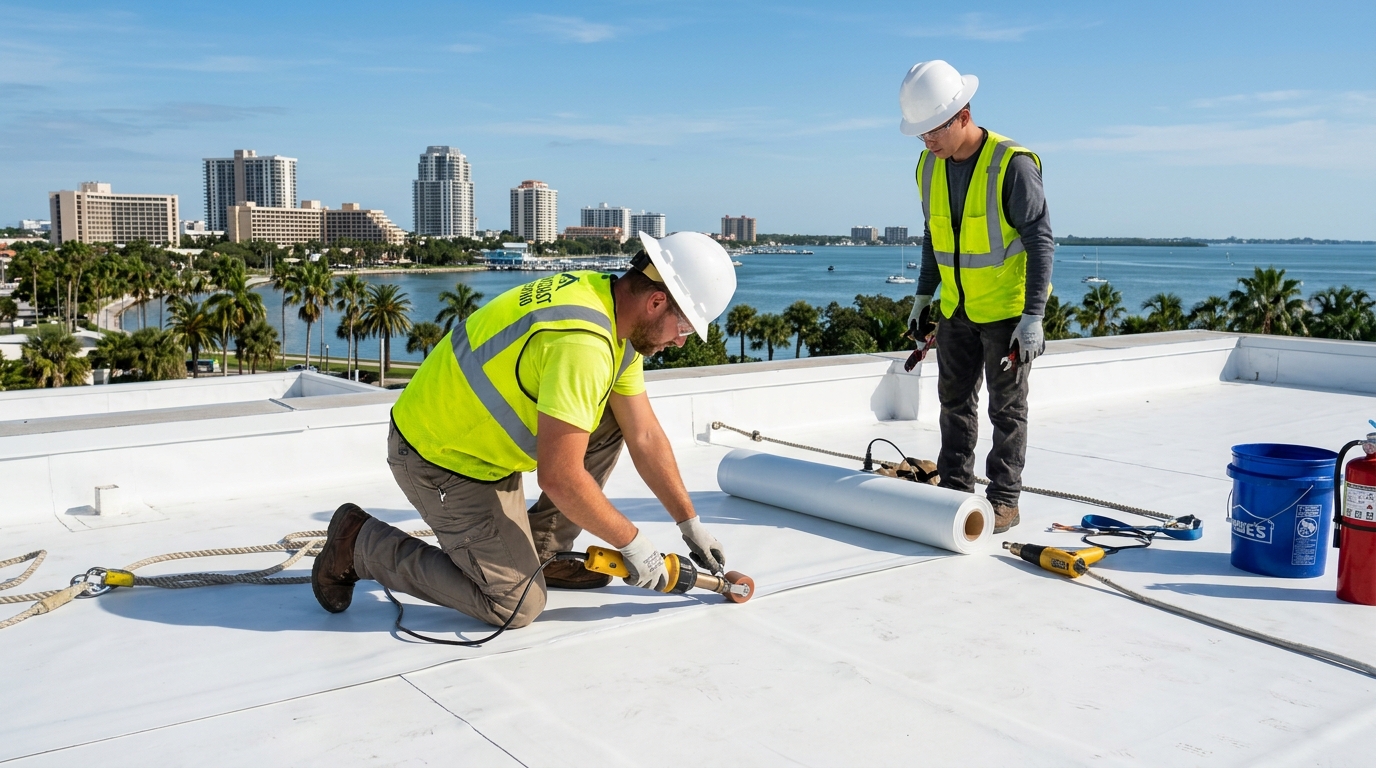
Permanent restoration of flat roof assemblies demands hot-air robotic or handheld heat welding for TPO and PVC systems, or multi-ply torch-down SBS modified bitumen applications for asphalt decks. Damaged membrane sections and waterlogged insulation are cleanly excised. New high-density polyiso insulation boards are mechanically fastened with heavy-duty plates, and a tapered insulation saddle is installed to eliminate low spots and redirect water toward commercial roof drains or scuppers. Membrane patches are fused using computerized hot-air welders creating monolithic seams stronger than the membrane itself.
Washington State Energy Codes & Contractor Licensing Compliance
All low-slope commercial and residential repairs conform to the Washington State Building Code (WSBC Chapter 51-50 WAC / 2021 IBC), Washington State Energy Code (WSEC), and Tacoma Municipal Code Title 2. Dispatched commercial roofing contractors maintain active general contractor licensing with the Washington Department of Labor & Industries (L&I) and carry full commercial liability and worker's compensation insurance.
Preventative Property Maintenance & South Sound Storm Preparedness
Commercial property owners and facility managers should schedule semi-annual drainage inspections every spring and autumn. Ensure internal roof drains, dome strainers, scupper boxes, and overflow drains are completely free of leaves, conifer needles, and silt buildup. Never allow mechanical HVAC service technicians to puncture roof membranes without certified roofing contractor oversight.
Emergency Homeowner Safety Protocol During Active Roof Breaches
Never attempt to access a wet, moss-covered roof or erect aluminum ladders near overhead electrical lines during rain or wind conditions in Pierce County. If water is dripping near ceiling light fixtures or electrical panel enclosures, immediately switch off the circuit breaker for that zone at your main electrical service panel. Place buckets to catch drips, puncture small pinholes in sagging sheetrock blisters to relieve pooled water weight safely, and call our emergency dispatch desk immediately at (888) 208-4155.
Frequently Asked Questions About Flat Roof Ponding Repair
How long can water sit on a flat roof before it causes permanent damage?
The roofing industry standard defines ponding as water that remains 48 hours after rain ceases. Persistent ponding breaks down membrane plasticizers, voids manufacturer warranties, and dramatically increases the risk of structural truss deflection.
Can a flat roof membrane be patched when it is wet outside?
Yes, using emergency cold-applied polymer elastomeric mastic compounds formulated to adhere to wet single-ply or modified bitumen surfaces. These provide an emergency watertight seal until dry weather allows permanent robotic heat welding.
What is the best flat roofing material for Tacoma's rainy climate?
Single-ply thermoplastic polyolefin (TPO) and polyvinyl chloride (PVC) membranes with hot-air welded seams provide outstanding durability against continuous standing water, chemical exposure, and moss growth in the Pacific Northwest.
Immediate Emergency Roof Dispatch in Tacoma
Speak directly with on-call South Sound dispatchers. Independent, licensed Washington roofing contractors standing by 24 hours a day, 7 days a week.
DISPATCH HOTLINE: (888) 208-4155